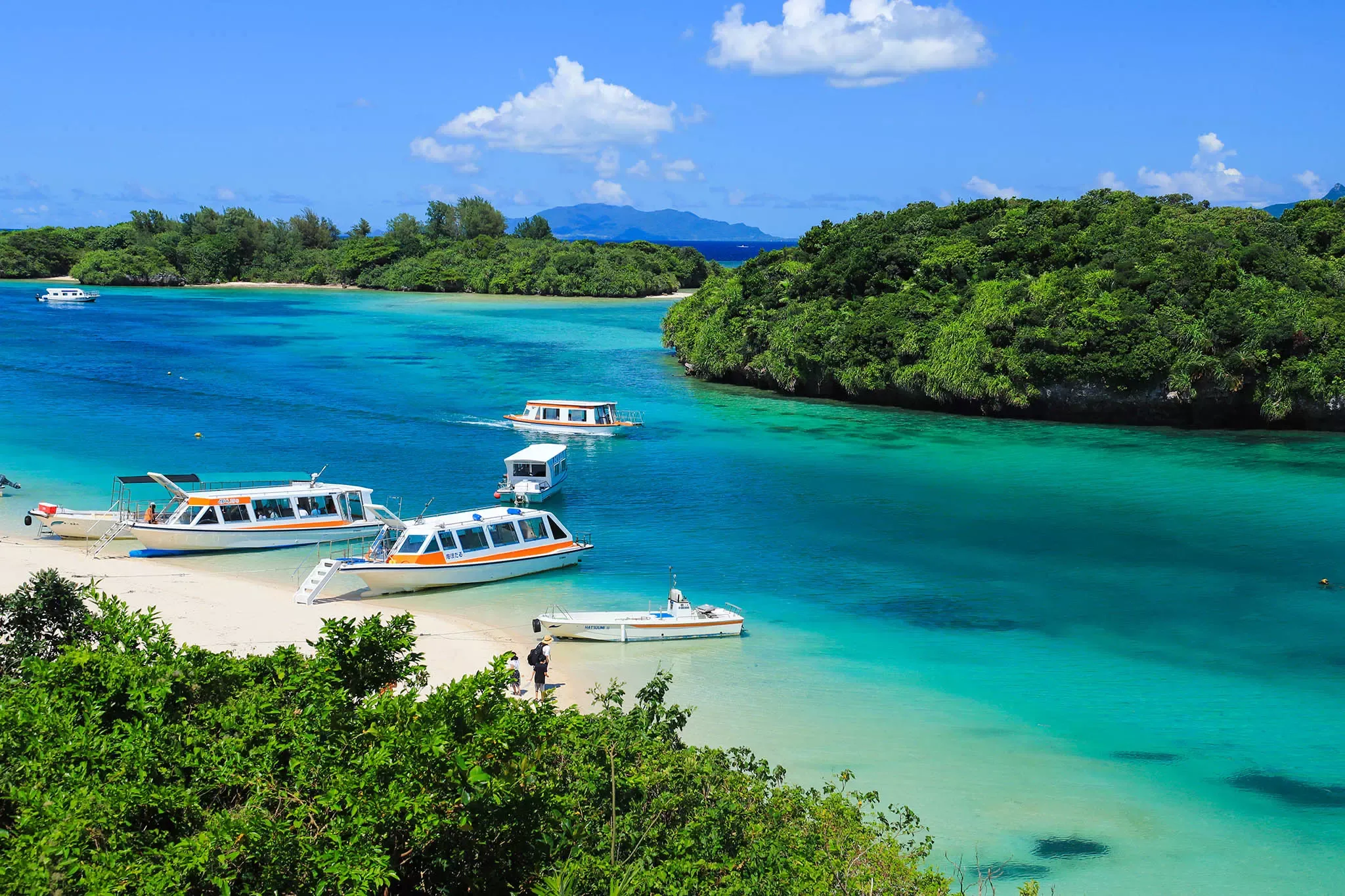
The road north of Nago loses confidence gradually. The highway narrows. Conbini signs thin out, then disappear. Somewhere past Ogimi, the forest stops being a backdrop and becomes the entire world, a dense, dripping wall of subtropical green that presses right to the asphalt edge and hangs overhead in a canopy so complete that afternoon light arrives filtered, diffused, turned into something soft and slightly unreal. You roll down the window and the air is different. It has weight. It smells of wet bark and something sweet and decomposing, the productive rot of a forest that has been doing this long before anyone thought to protect it.
I pulled off the road somewhere in Kunigami Village and sat for a while with the engine off. The forest sounds arrived in layers: the mechanical trill of cicadas first, then underneath that a liquid birdsong I couldn't identify, and below that, if I stilled myself enough, the particular silence of a place with no traffic, no construction, no human project underway. A pair of pigeons crossed the gap in the canopy above. Something rustled in the undergrowth to my left and didn't show itself.
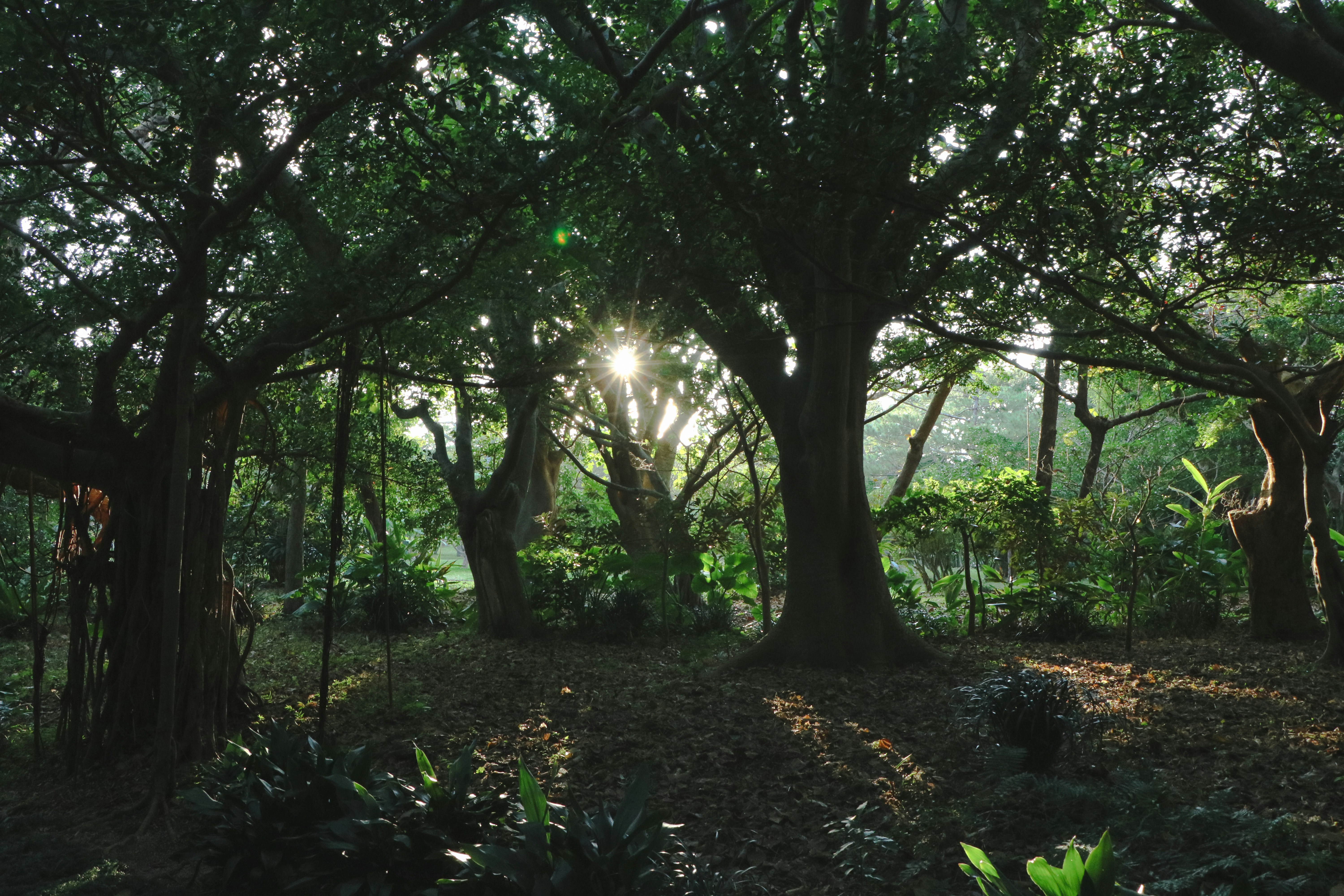
This is Yanbaru Okinawa, the far north, the part most visitors to this Okinawa island never reach. While the southern resorts fill and the beaches of Naha's coastline host another thousand snorkellers keen to snorkel the coral shallows offshore, up here the world is extraordinarily quiet. There are no resort hotels on this stretch of road. There are no beach bars. There is, instead, one of the last intact subtropical forests in East Asia, a UNESCO World Heritage landscape that harbours creatures found nowhere else on Earth, and — if you slow down enough to deserve it, a nature of Yanbaru that is genuinely rare.
What Is Yanbaru?
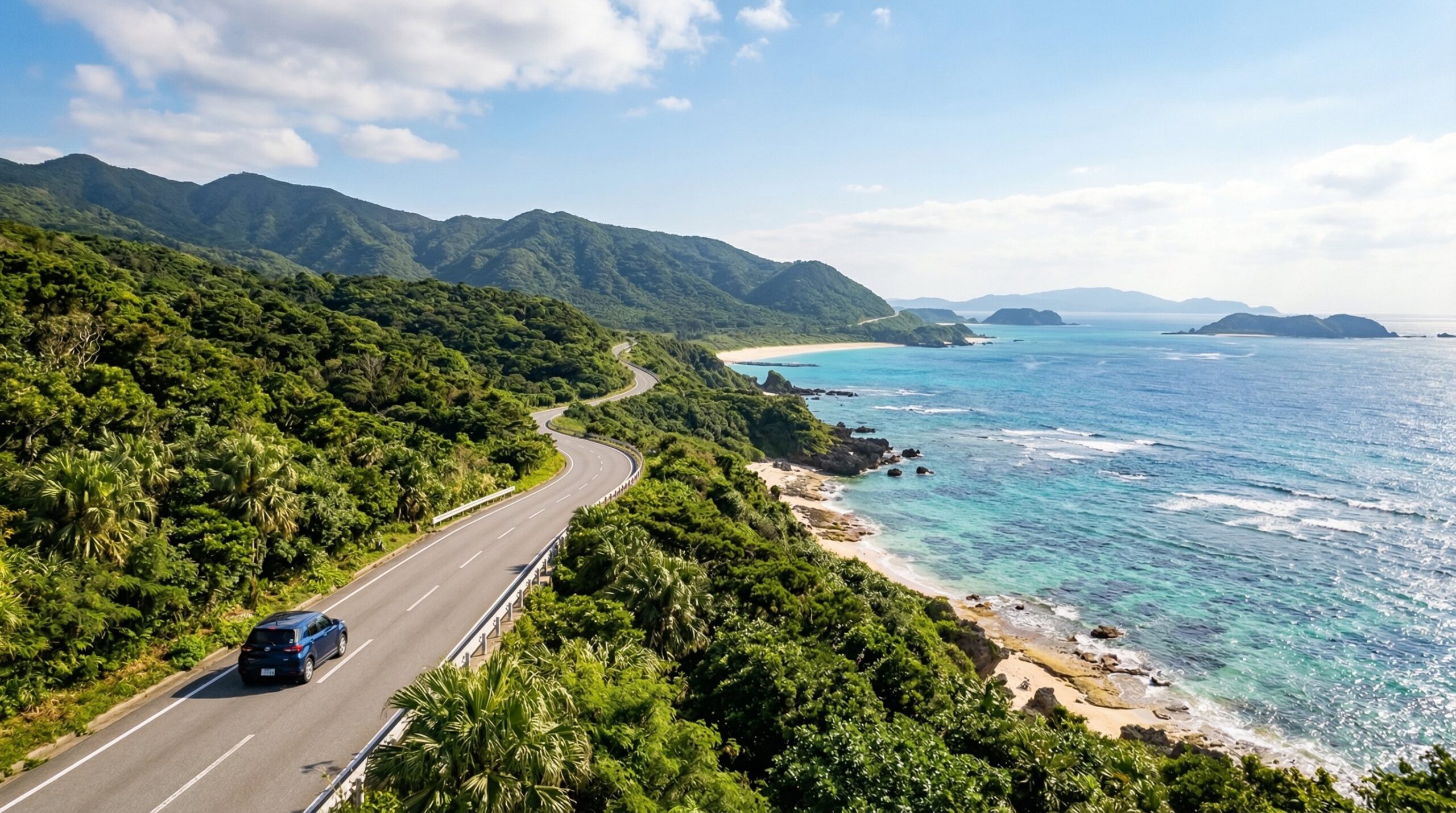
The word comes from the Okinawan dialect and means, roughly, densely forested mountains. It is not a place name in the precise administrative sense but a term locals use for the forested northern quarter of Okinawa's main island, the three villages of Kunigami, Ogimi, and Higashi, which together cover the upper third of Okinawa Hontō. Drive north from Nago City, which functions as the last urban outpost before the landscape takes over, and within twenty minutes the change is unmistakable. The hills steepen. The road winds. Roadside mirrors appear at blind corners, put there not for cars but to help drivers spot Okinawa Rails crossing the asphalt.
Yanbaru National Park was established on September 15, 2016, Japan's 33rd national park, covering 173.52 square kilometres of land and nearly 4,000 hectares of adjacent marine territory along the northern coastline. The park formalised what ecologists had understood for decades: this corner of Okinawa is not just scenically pleasant but biologically extraordinary. Its subtropical evergreen forests, limestone ridges, tidal mangroves, and coastal cliffs form an interconnected ecosystem unlike anything else in Japan. The biodiversity of the Yanbaru forest is, by any global measure, exceptional, a concentration of endemic plants and animals that rivals ecosystems far larger in area.
The international recognition came five years later. In July 2021, at the 44th session of the UNESCO World Heritage Committee, northern Okinawa was inscribed as a UNESCO World Natural Heritage Site and World Heritage Site, not in isolation, but as part of a four-island designation alongside Amami-Oshima and Tokunoshima in Kagoshima Prefecture, and Iriomote Island to the southwest. The shared inscription criterion was biodiversity: these islands collectively represent the most species-rich temperate-to-subtropical transition zone in the world, a remnant of ancient land bridges between the Asian continent and the Pacific archipelago.
The question visitors sometimes ask is why, in an island prefecture as developed and touristically saturated as Okinawa, a wilderness this intact survived at all. The answer is layered. Part of it is geological — the northern hills are steep, their rivers fast-running, the terrain resistant to the flat coastal development that consumed the south. Part of it is historical: the Battle of Okinawa in 1945 caused catastrophic destruction in the south and left the north comparatively untouched, and in the post-war period the US military administration used large tracts of northern land for training ranges, inadvertently sealing them against civilian development. When those areas were eventually returned, conservation instincts had strengthened enough to protect them. And part of it is simply the character of the three villages, Kunigami, Ogimi (famous across Japan as a longevity village, home to an unusual concentration of centenarians), and Higashi, whose residents have historically lived in close relationship with the forest and understood its value in terms that predate the language of ecology. It is this enduring bond between people and place that gives Yambaru, as the forest is sometimes called in the local dialect, the charm of a miracle forest: a living ecosystem that community stewardship helped preserve.
The result is a landscape that functions as a genuine wilderness within an hour's drive of a city. It is not pristine in the scientific sense, feral cats and mongooses, introduced at various points in Okinawan history, remain serious threats to ground-nesting birds. But the forest itself is old, deep, and alive in ways that announce themselves the moment you step off the road and into the trees. The beauty of Yanbaru is not a postcard beauty; it is something you feel before you see it.
The Wildlife of Yanbaru
To understand why Yanbaru matters to biologists, you have to understand what island isolation does to evolution over millions of years. The Ryukyu Archipelago was periodically connected to and severed from the Asian continent as sea levels fluctuated during glacial cycles. Populations of animals that arrived during connected periods became isolated when the sea rose again, and over tens of thousands of generations they diverged, adapted to their specific forest, their specific food sources, their specific predators, until they were something new. Yanbaru is the result of that process, and the plants and animals it produced exist in no other place on Earth. To immerse yourself in this forest is to encounter biodiversity shaped by deep time.
The Okinawa Rail (Yanbaru Kuina)
The Yanbaru Kuina is the animal most visitors come hoping to see, and with good reason. It is Japan's only flightless bird — a small, compact rail with brick-red legs, a vermillion bill, and a body barred in chestnut and white that looks almost comically under-designed for a creature living in a forest full of predators. Its wings are vestigial, good for nothing aerodynamic. It survives on the forest floor through alertness and speed, darting between the ferns on those vivid legs with an urgency that seems slightly panicked even when nothing is chasing it.
Finding one without help is genuinely difficult, and honest guides will tell you so. The birds are present throughout the forest in the three northern villages, but they are more often heard than seen — a sharp, repetitive call that carries well through the trees but gives no precise location. The best solo strategy is to drive the forest roads at dusk, very slowly, and watch the road edges. This is most productive from May through June, when adults are moving chicks between feeding sites and the family groups cross roads repeatedly. The Okinawa Rail Observatory near Cape Hedo at the island's northern tip provides an elevated platform from which patient visitors sometimes get clear views, especially in early morning. Spotting an endemic bird like the Yanbaru Kuina in its natural habitat, a heritage site setting shared by no other rainforest in Japan, is one of those encounters that travel doesn't easily replicate.
But patience alone is not always enough. When a local guide pointed one out to me from a metre away, the bird frozen in the roadside grass, watching us watch it, I understood immediately that I had been looking in entirely the wrong way. Guides who know the Kuina's specific haunts, its habit of using the same crossing points day after day, can put you in the right position with a precision that no trail map provides. Evertrail Tours, a small-group operator based in northern Okinawa, runs a four-day Yanbaru itinerary (the Yanbaru to Izena experience) that builds wildlife observation into its structure at the right times of day, and the difference between that kind of guided presence and self-directed searching is substantial. For birdwatchers with a specific Kuina target, it is worth considering honestly.
The road-crossing risk cuts in both directions. The same behaviour that makes the Kuina visible, its willingness to cross open ground, makes it fatally vulnerable to cars driven at speed. Road mortality is one of the leading threats to the species. Drive slowly, especially at dusk, especially in May and June.
The Okinawa Woodpecker (Noguchi Gera)
The Noguchi Gera is Japan's rarest woodpecker, endemic to Yanbaru and found only in old-growth forest where trees are large enough to provide the deep cavities it requires for nesting. It is a substantial bird — larger than you might expect, with a dark body and that distinctive crimson crown, and when it is working on a dead tree it is loud enough to locate by sound alone. The challenge is that old-growth forest in Yanbaru is not uniformly distributed: the woodpecker concentrates in the larger, older trees of the interior ridges, away from roads. The sight of this renowned bird descending a moss-draped trunk, framed by the breathtaking scale of the old-growth canopy, rewards the search. A local birding guide with knowledge of active territories will dramatically improve your odds.
The Ryukyu Robin and Other Endemics
The Ryukyu Robin is one of the forest's more accessible delights, a small, orange-fronted bird that sings with a sweetness that seems disproportionate to its size and that is often among the first voices of the dawn chorus. In the early morning, from any position inside the forest edge, you will hear it long before you see it. Yanbaru and the other World Heritage islands together support approximately 300 bird species, including six endemics, three of which are found in Yanbaru specifically. For visiting birders, this is a list of global significance.
The Yanbaru Long-Armed Scarab Beetle
If the Kuina is the celebrity of the daytime forest, the Yanbaru long-armed scarab beetle owns the night. The male of the species is extraordinary to look at — its forelegs extend to nearly the length of its body, used in combat with rival males over females and feeding sites on the sap of old trees. It is one of the largest beetles in Japan, and it is strictly nocturnal, spending the day buried in decaying wood and emerging after dark to move through the canopy. Seeing one requires either significant luck or a night tour guide who knows the old trees where they concentrate.
Reptiles and Amphibians
Yanbaru's reptile and amphibian fauna is equally remarkable. The Okinawan Ishikawa's frog, said by Japanese naturalists to be the most beautiful frog in the country, with a vivid green and gold patterning, inhabits the clear streams of the forest interior. The Kuroiwa's ground gecko, another endemic, moves through the leaf litter at night with a silence that makes it easy to miss entirely. Across the four World Heritage islands, approximately 36 species of land reptiles exist, of which 23 are endemic, a density of endemism that is exceptional by any global standard.
The Mangrove Ecosystems
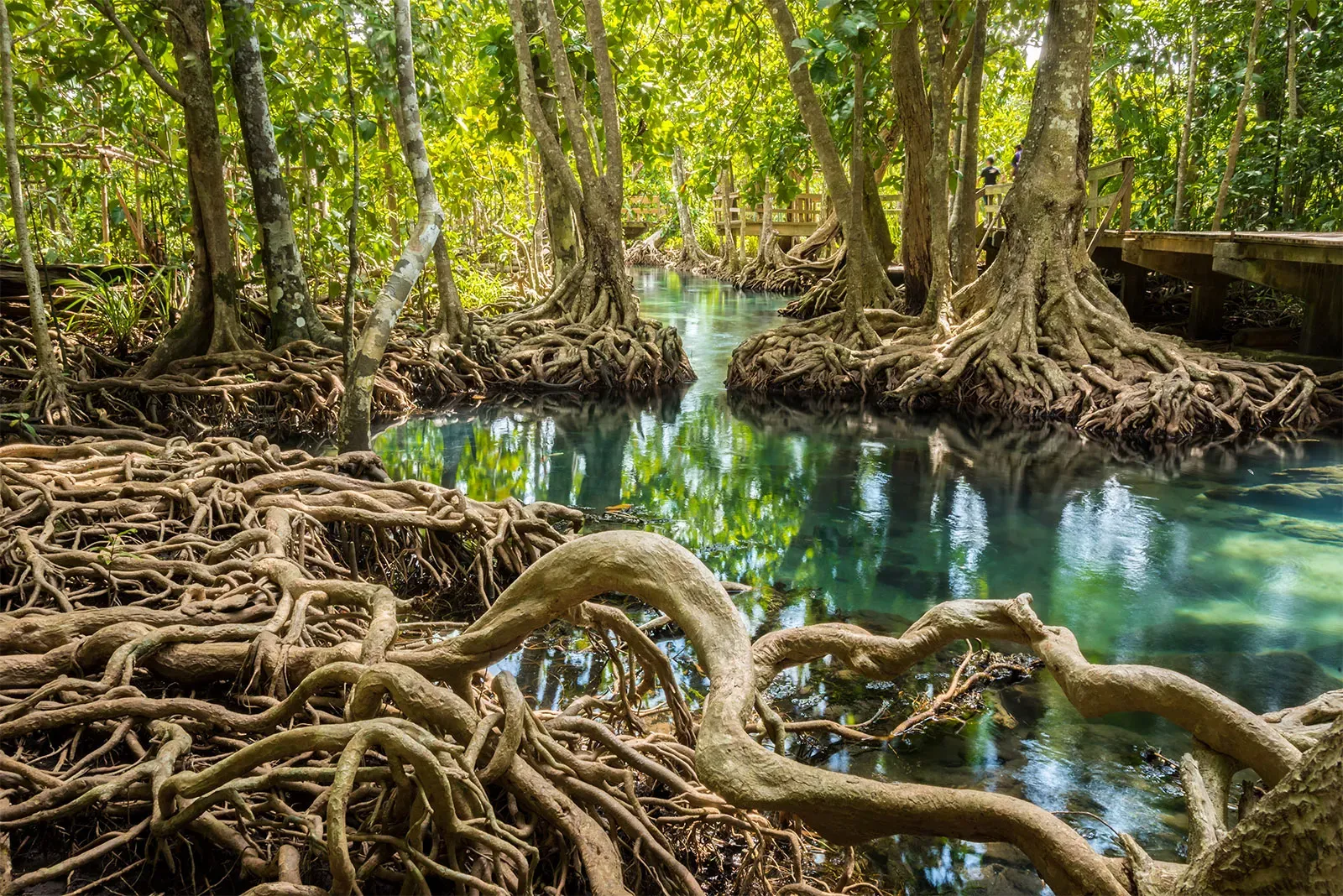
Yanbaru's wildlife does not begin and end with the forest. The tidal estuaries of the east coast support a different but equally productive ecosystem. Gesashi Bay's mangroves harbour mudskippers, those improbable fish that haul themselves out of the water on modified fins and blink at you with protruding eyes, along with fiddler crabs, multiple heron species, and the endemic Ryukyu Kingfisher. Beyond the mangrove mouth, the clear shallows hold tropical fish threading through coral heads visible from the surface. The mangroves function as nursery habitat for a wide range of marine species and as a buffer zone between the forest and the sea. Visiting them by canoe or kayak at high tide, with the light coming through the root systems in shifting columns, is one of the more quietly remarkable experiences Yanbaru offers, as distinctive in its way as anything you will find when you explore the forests of the interior.
How to Explore Yanbaru
Yanbaru is not a destination that rewards passive tourism. It is a landscape that requires some engagement, some willingness to hike a muddy trail, trek a river gorge, get wet, wake early, drive slowly, and accept that the forest will show you what it chooses to show you. The thrill of this place is earned rather than delivered. The experiences below range from gentle to genuinely active, but all of them share the quality of being unhurried.
Hiking: Forest Trails and Waterfalls
The most accessible introduction to Yanbaru hiking is the trail to Hiji Waterfall, a 26-metre cascade at the end of a 1.5-kilometre walk through old-growth forest in Kunigami Village. The trail takes approximately 40 minutes each way and gains moderate elevation through a canopy of indigenous tree ferns, hikage hego ferns, and flowering subtropical shrubs. It is manageable for most fitness levels and is one of the few trails in Yanbaru where the forest itself, rather than the destination, earns its place as the primary attraction. The waterfall, when you reach it, is beautiful, the water falling clean into a dark pool with mist rising off it, but it is the forty minutes of walking through that particular quality of light and sound that stays with you.
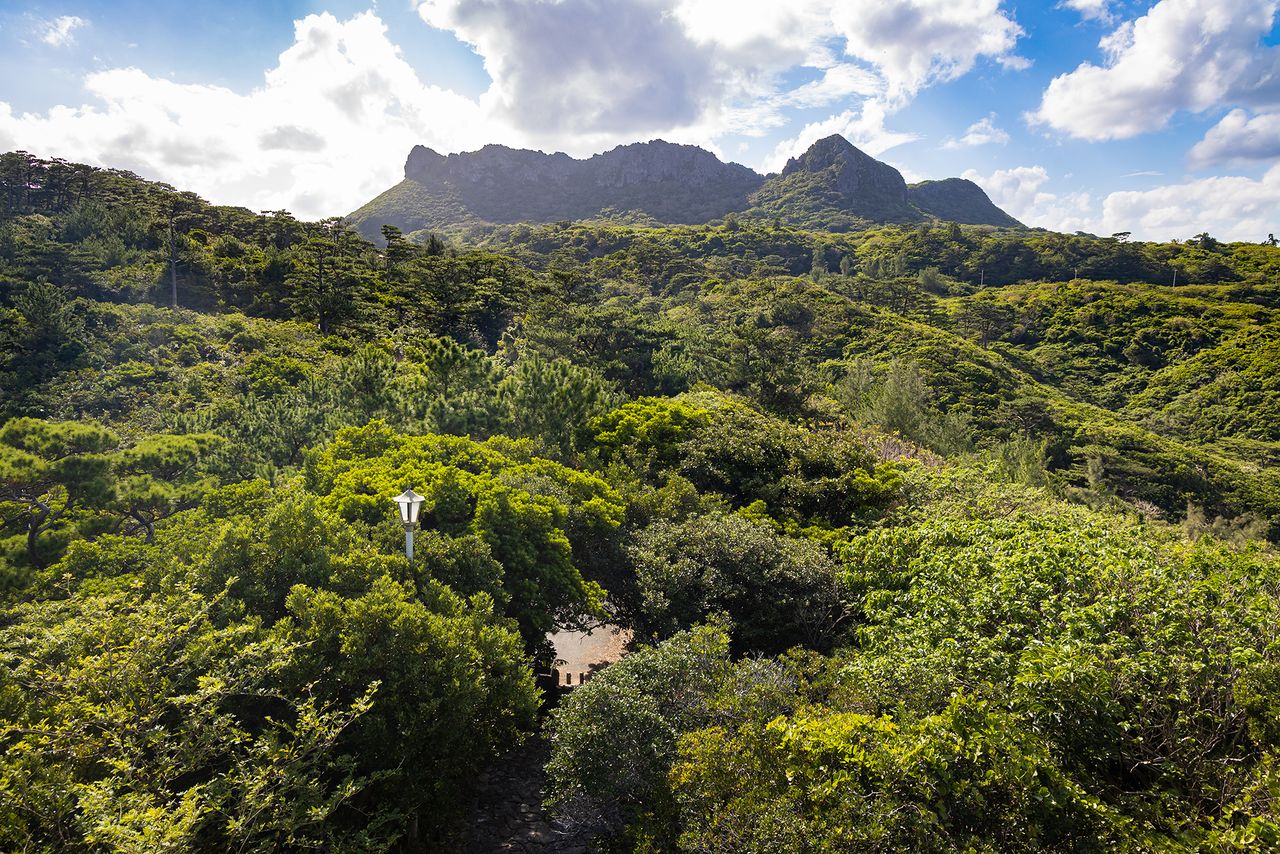
For something more geological, Daisekirinzan Park sits five minutes by car from Cape Hedo at the island's northern tip. The park's three trail loops wind through eroded limestone karst terrain, a rocky, dramatic landscape of pinnacles and caves and ancient formations that feel utterly unlike the forest. A shuttle bus runs from the car park to the trail entrance. Each loop has its own character; the shortest takes about thirty minutes and is accessible to almost everyone; the longest requires a full hour and some scrambling. From the highest points, panoramic views open over the northern coast, coastal scenery that stretches to the horizon in both directions, with the jagged limestone karst ridge rising above the treeline in sharp relief.
The trails around Cape Hedo (Hedo Misaki) itself offer something more elemental: the northernmost point of Okinawa Hontō, where the East China Sea and the Pacific Ocean meet in a visible collision of currents. On a clear day, Yoronjima, technically part of Kagoshima Prefecture, is visible 23 kilometres to the northwest. The cape's walking network is compact but rewards time spent at the cliff edges, watching the water churn below; the vantage point here is one of the most scenic on the entire island. Beyond the marked trails, the forest roads of Kunigami and Higashi villages offer informal walking, slower, undirected, and in some ways more rewarding than any designated trail.
Mangrove Kayaking
At Gesashi Bay on the east coast of Yanbaru, the largest mangrove forest on Okinawa's main island spreads across ten hectares of tidal estuary and coastal fringe. The Japanese government designated it a national natural monument in 1972, fifty years before the UNESCO inscription recognised its wider significance. Walking the 400-metre elevated boardwalk gives you an impression of the scale; paddling into it at high tide gives you something entirely different.
Mangrove kayaking Okinawa-style is gentler than the phrase might suggest, the Gesashi River is calm, the currents mild, and the experience is primarily one of quiet immersion. The Yanbaru Club, based on the Gesashi River, offers high-quality English-language tours in two formats: a 1.5-hour canoe or kayak journey up to the mangrove-filled upper reaches, and a 2.5-hour extension that continues to a river tributary and, in suitable sea conditions, out to the open ocean. Operating hours follow tidal schedules, tours run only during high tide, which typically means morning departures, so it is worth booking at least a week or two in advance and confirming the departure time when you do.
As you paddle upstream, the light changes. The mangrove root systems, the arching prop roots of the Rhizophora and the pneumatophores of the Avicennia poking up through the mud, create a visual complexity that photographs cannot quite capture. Mudskippers perch on exposed roots and regard the kayaks with what appears to be mild contempt. Herons pick their way along the tranquil banks. The sound is birdsong and paddle-drip and, occasionally, the distant call of something in the forest beyond the treeline. It is, in the best sense, uneventful.
Complete beginners are genuinely welcome, the river does not require whitewater skills or any prior paddling experience. Bring a change of clothes and footwear you are prepared to get wet.
Night Tours
Visiting Yanbaru without doing at least one night tour is a significant omission. The forest is a different world after dark, louder in some registers, quieter in others, and populated by creatures that spend the daylight hours invisible. The Ryukyu Scops Owl calls from somewhere close. The long-armed scarab beetle moves through the treetops. And the Okinawa Rail, freed from the alert caution it maintains during the day, moves more openly along the forest roads.
A Yanbaru night tour typically runs approximately two hours: April through October, departures are from 20:00 to 22:00; November through March, from 19:00 to 21:00. Guides use red-filtered torches, which allow observation without startling the wildlife. The experience is not guaranteed, the forest makes no promises, but the probability of meaningful sightings is substantially higher than any daytime solo walk.
Evertrail Tours' northern Okinawa experiences include guided night wildlife components as part of multi-day itineraries, the 3 Day 2 Night Northern Okinawa Experience and the Yanbaru to Izena four-day tour both incorporate evening forest time with guides who know where the animals are and, equally important, how to approach them without causing disturbance. For independent travellers who prefer to arrange night tours separately, the Yanbaru Discovery Forest (Yanbaru Manabi no Mori) in Kunigami operates guided evening programmes and can arrange English-language support. English availability varies; a translation app and good-natured patience go a long way.
Come in long trousers and sleeves regardless of the season, the forest is humid, the undergrowth is close, and the insects are enthusiastic.
River Trekking
Yanbaru's rivers are fast, clear, and cold in a way that feels improbably refreshing in the subtropical heat. River trekking here — wading upstream through jungle gorges, scrambling over boulders, using a rope to descend slick rock faces, sliding down natural chutes into plunge pools — is one of the more physically exhilarating things the forest offers. The natural beauty of these gorges is unforgettable: sunlight breaking through the canopy onto white water, walls of fern and moss rising on either side. Several operators in the northern villages run guided river trekking experiences, typically lasting half a day, that combine wading, swimming, and waterfall exploration in sequences that vary by season and water level.
The Aha Dam reservoir offers a quieter alternative, kayaking on still water surrounded by old-growth forest, with the ridge wall reflected in the surface and the birdsong echoing off the hillsides. It suits those who want the water experience without the physical demands of river trekking.
For families, the eight-wheel jungle buggy tours operating in Higashi Village are worth knowing about, open to participants from age four, they cover forest terrain that would be inaccessible on foot and offer an element of mechanical adventure alongside the nature observation. Combine this day with an excursion north to Shioya Bay, where the calm waters frame the village shoreline beautifully, or loop west toward Kouri Island for a contrast of turquoise sea against the forest-dark interior you have spent the day inside.
Cultural Sites
Yanbaru is not only a natural landscape. The forest and the villages within it carry deep cultural significance that runs alongside the ecological story, and a trip that ignores this dimension is incomplete.
Nakijin Castle (Nakijin-jô), on the western edge of the Yanbaru region, is a 14th-century Gusuku fortress that served as the seat of the Northern Kingdom during Okinawa's era as the independent Ryukyu Kingdom. The castle walls climb a dramatic hillside overlooking the ocean and the northern coast, and the site's parklands, particularly spectacular during cherry blossom season in January and February, when Okinawa's early-blooming kanhizakura light the grounds pink, deserve more time than most visitors give them. Local guide Ichiro Kikuta, who has worked the Nakijin site for over fourteen years, describes the place as becoming more profound the more you learn about it; a single visit barely scratches the surface.
The utaki, sacred groves dotted throughout the Yanbaru villages where local communities historically performed rituals and maintained relationships with the forest's spiritual dimensions, remain places of active worship. Approach them with the same respect you would give a functioning religious site anywhere: quietly, without photographing the interior unless invited, and without entering areas marked as restricted.
In Ogimi Village, the old hamlet arrangements survive more intact than almost anywhere else on the main island, traditional stone walls, lanes lined with rows of fukugi (Garcinia) trees planted in orientations that follow feng shui principles toward the sea, and a pace of life that is genuinely unhurried. Ogimi's reputation as Japan's longevity village is not a tourist invention; it has been studied by gerontologists and is generally attributed to a combination of diet, social structure, and the particular lifestyle that comes from living embedded in a landscape rather than superimposed on it. Traditional Okinawan customs run deep here, the harvesting of shikuwasa citrus from roadside trees, the use of local cuisine built on vegetables, tofu, and island pork, and a sense of communal identity that outsiders are quietly invited to observe rather than consume. For something more active on the water, a sabani excursion, the flat-bottomed wooden sailing craft traditional to the Ryukyu islands, offers a glimpse of the seafaring culture that once connected these villages to the wider Pacific world.
Birdwatching
For visiting birders, Yanbaru is not a nice addition to an Okinawa trip, it is the reason for the trip. The four World Heritage islands together support approximately 300 bird species; in Yanbaru specifically, you have a realistic chance of three of the six island endemics in a single morning. Beyond the Kuina, Noguchi Gera, and Ryukyu Robin, the forest supports Okinawan subspecies of the varied tit, Japanese white-eye, narcissus flycatcher, and ruddy kingfisher, all of which look and sound subtly different from their mainland equivalents.
The best approach is the Ibu viewpoint in Kunigami Village, where the sunrise over the east coast coincides each morning with a dawn chorus of remarkable intensity. Ichiro Kikuta, who combines the roles of wildlife artist, naturalist, and birding guide, can identify every species in that chorus by ear, a skill that takes decades to develop and that transforms the experience for anyone who has stood in a subtropical forest not knowing what they are hearing. The scenery from the Ibu ridge at first light, ocean to the east, forested hills receding inland, is, on a clear morning, genuinely extraordinary.
The Yanbaru Discovery Centre (Yanbaru Manabi no Mori), accessible via a forest road about four kilometres south of Route 2, sits in the middle of a productive area for all three target endemics and serves as the best operational base for a serious birding day. Arrive before dawn, stay until mid-morning, then relocate to a different section of forest for the afternoon.
.webp)
Planning Your Visit
Getting There
There is no substitute for a rental car in Yanbaru. Public transport runs as far as Nago City, and a limited village bus operates in Kunigami on restricted schedules, but the sites, trailheads, and wildlife zones that matter, Cape Hedo, Daisekirinzan, the Hiji Waterfall trailhead, the Gesashi mangroves, the inland forest roads, are impossible to reach by bus without losing most of a day to connections and waiting.
From Naha, the drive to the heart of Yanbaru takes approximately two hours. The western route via Highway 58 runs through Nago City and up the coast, faster, more straightforward, and better for a first arrival. The eastern route via Route 329 is slower and more winding but runs through Higashi Village and past the Gesashi mangroves, making it the better choice if you want to arrive with the forest already in view. For the drive itself: do not underestimate the narrowness of the northern roads. The forest lanes require care, especially at night, and the standard Japanese rental car coverage policies vary in their treatment of wildlife collisions. Drive at appropriate speeds throughout.
How Long to Stay
Two nights in Yanbaru is the honest minimum, enough for one full day of activities and one night tour, with travel time absorbed. Three nights is what the place actually deserves: a day for the eastern coast (Gesashi mangroves, Higashi Village, river trekking), a day for the northern forest (Hiji Waterfall, Daisekirinzan, Cape Hedo), and a third day for birdwatching and the slower pleasures of village walking and looking. Day-tripping from Naha or Nago is technically possible but misses the night wildlife entirely and leaves no room for the particular decompression that makes Yanbaru work on you properly.
Where to Stay
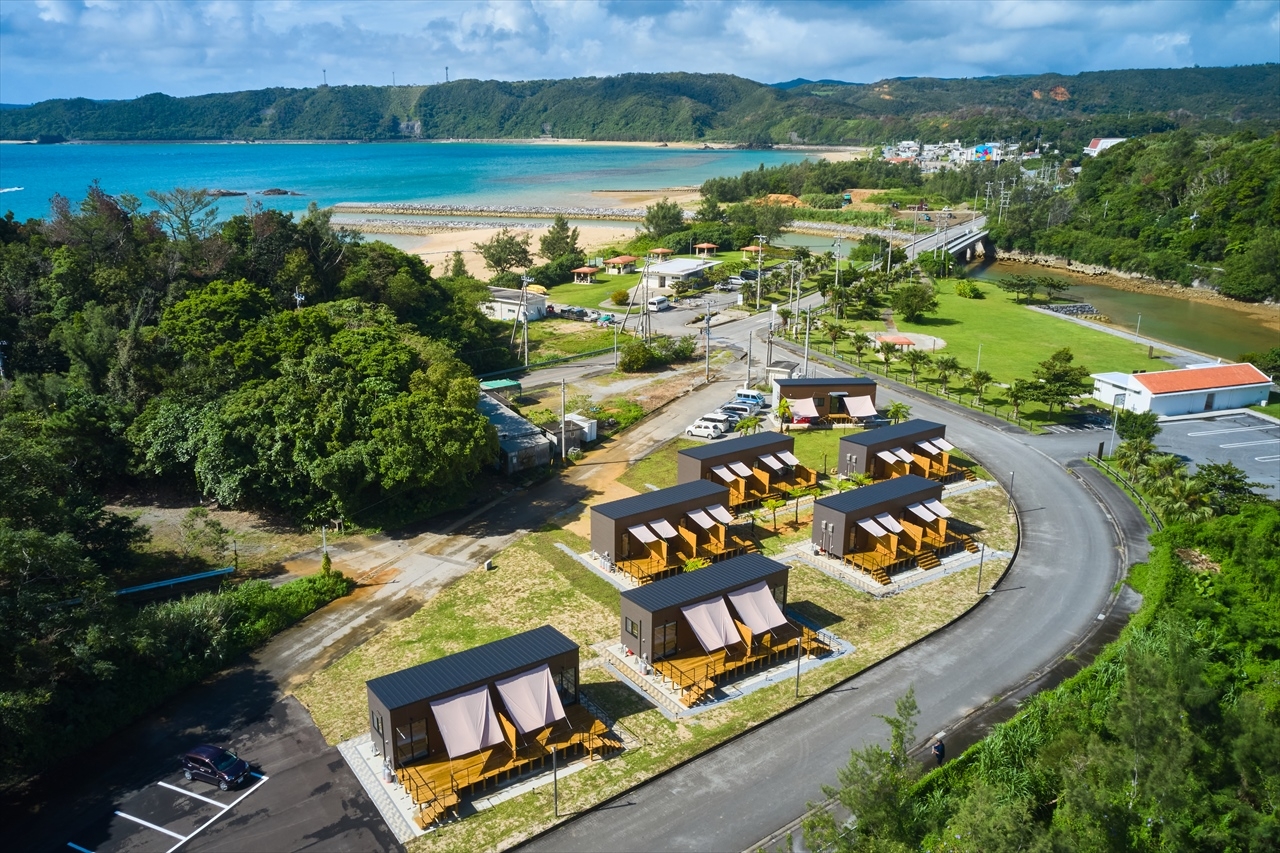
Accommodation in Yanbaru is limited by design and better for it. The Yanbaru Discovery Forest (Yanbaru Manabi no Mori) in Kunigami offers lodge-style accommodation that places you directly inside the forest zone and facilitates easy access to early-morning wildlife and nighttime evening tours. Hoshinoya Okinawa, located slightly south of the deepest forest but within reach, offers a luxury alternative with its own guided kayaking programme and the kind of architectural integration with the landscape that justifies the premium. When you plan your visit, consider that the villages fill quickly in spring and autumn; book accommodation at least two to three weeks ahead.
In Ogimi and Higashi villages, small guesthouses and minshuku (family-run lodgings) offer a more modest and arguably more honest immersion, you eat what the village produces, you sleep to the sound of the forest, and you leave with a sense of the place that no resort can replicate.
Best Seasons
The question of the best time to visit Yanbaru depends entirely on what you are there for. April through June is peak season for wildlife observation: breeding season brings the Kuina to maximum activity, the dawn chorus is at its fullest, and the forest floor is populated with nesting reptiles and early-emerging beetles. The trade-off is the rainy season, which arrives in May and runs through mid-June, trails become muddy, some roads flood briefly, and photography requires patience.
November through March offers the most comfortable Yanbaru hiking conditions, cooler temperatures, lower humidity, and the forest in a quieter but still productive state. January and February bring Nakijin Castle's cherry blossoms. The birding remains excellent; the night tours become shorter but no less rewarding.
July and August present a different calculus. The forest is at its most lush and the long evenings suit extended exploration, but typhoon season peaks in August and September. Typhoons in Okinawa are not minor weather events; they close roads, ground flights, and can make large sections of the northern coast genuinely dangerous. If you visit in summer, check the Japan Meteorological Agency forecasts daily and have a contingency plan for the itinerary if a system approaches.
What to Pack
Hiking footwear with grip is essential, the trails are frequently muddy after rain, and the limestone terrain at Daisekirinzan requires purchase on slick rock. Carry more water than you think you need; the subtropical humidity makes it easy to underestimate fluid loss. A light rain shell is useful year-round. For wildlife observation, bring binoculars — even a modest pair transforms bird encounters from silhouettes to identifiable individuals. Long trousers and sleeves for evening are a kindness to yourself given the insect activity.
Cell Service Warning
North of Nago City, mobile coverage becomes unreliable. In the interior forest zones, you may have no signal at all. Download offline maps, Google Maps or Maps.me both offer good coverage of the northern roads, before you leave your accommodation. Share your rough itinerary with someone who can notice if you don't check in. This is not an alarmist precaution; the forest is not dangerous, but it is genuinely remote, and a flat tyre on a forest road with no signal is a different situation from a flat tyre in the southern suburbs.
Conservation Rules
Yanbaru is a living conservation zone, and the rules that govern visitor behaviour reflect that status. Stay on marked trails in designated areas. Do not feed any wildlife, this applies especially to the Okinawa Rail, whose habituation to humans increases its road-crossing risk near settlements. Do not take animals, plants, or rocks. Do not enter restricted areas around nesting sites, which are marked seasonally. When driving at night, especially during the May–June Kuina chick-rearing period, reduce speed substantially on forest roads, the cost of those few extra minutes is negligible; the cost of a wildlife collision is not. Exploring Yanbaru sustainably and responsibly is not an abstract ethical position; it is the practical condition under which this landscape survives for future generations.
A 2-Day Yanbaru Itinerary
Day One: The Eastern Coast and the Forest After Dark
Begin the morning with the mangroves. Gesashi Bay's kayak tours run on tidal schedules, which means the departure time is determined by the day's high tide, typically somewhere in the morning hours, but confirm when you make your booking. The Yanbaru Club on the Gesashi River takes beginners without hesitation; the 1.5-hour canoe tour is sufficient for a first encounter, and the 2.5-hour extension to the tributary is worth it if you have the time and the arms for it. Custom group departures can sometimes be arranged for private parties; enquire when booking. Allow yourself to go slowly, to stop paddling periodically and let the boat drift in the current, to look into the root systems rather than past them.
After the kayak, dry off and drive through Higashi Village for lunch. The village sits on a bay with views across to the Kume Island coastline, and the small local restaurants serve the kind of traditional Okinawan cuisine, Rafute pork belly braised in awamori and soy, goya champuru with its characteristic bitterness, handmade soba noodles — that you will not find approximated in the south. This is not a tourist lunch; it is a working village's midday meal, rooted in custom and made from what the land and sea provide.
In the afternoon, head northwest toward Kunigami for the Hiji Waterfall trail. The 1.5-kilometre path from the trailhead takes forty minutes at a calm pace, though the forest will slow you down with distractions, the fern colonies, the scale of the old trees, the way the light pools and disperses at different points along the trail. The waterfall itself is 26 metres tall, falling clean into a pool surrounded by old growth. Sit with it for a while before heading back; the return walk in the direction of the car feels different from the walk in.
Check into your accommodation before the evening meal, then prepare for the night tour. Dress in long sleeves and trousers, bring a small torch if you have one (guides carry the specialist equipment, but a personal light is useful for uneven ground), and adjust your expectations away from documentary-style wildlife spectacle. Night tours in Yanbaru reward slow attention rather than dramatic encounter, the moment of finding a Kuina crouched in the torch beam, watching it watch you from two metres away with those vivid legs and that ancient, unamused expression, is understated in the best possible sense. If the beetles are active, the guides will know where to look.
Day Two: The Deep North and the Road Home
Wake early. This is non-negotiable if you are serious about birds. The dawn chorus in Yanbaru peaks in the forty minutes before and after sunrise, and missing it to sleep in is a genuine cost. Drive to the Ibu viewpoint or position yourself near the Yanbaru Discovery Centre before first light and be still. The Ryukyu Robin will sing. If you are fortunate, and in the right season, with the right conditions, the Kuina will call from somewhere close in the undergrowth, a sharp repeated note that carries and carries.
After breakfast, drive north to Cape Hedo. The Daisekirinzan karst trails open early and are best visited before the tour buses arrive from the south, the limestone formations have a particular quality of stillness in the morning that the afternoon crowds disrupt. Take the middle trail if time is limited; it combines the most geological drama with a manageable time commitment. Then walk out to Hedo itself, to the northernmost point of the island, and spend whatever time you can. The water is startling there, the colour change where the two seas meet, the spray off the rocks below, the open ocean visible as a wide expanse beyond the cape. The natural beauty of this spot is not subtle.
The drive south in the afternoon is its own experience. If you have not yet taken the eastern Route 329, take it now, the road hugs the Pacific-facing coast through Higashi and past the Gesashi Bay turnoff, and the light in the late afternoon on that coastline is the kind of thing travel writers reach for inadequate adjectives to describe. Stop at Nakijin Castle on the western approach if the light holds; the ruins are at their most atmospheric in the hour before closing, when the other visitors have mostly left and the hillside path is quiet.
The forest does not require a dramatic departure. You drive south and it gives way to Nago's supermarkets and traffic signals and the flyover that puts you back on the expressway. What Yanbaru leaves with you is subtler than a postcard moment. It is a recalibration of baseline, a few days of genuine quiet and genuine wildness that makes the ordinary world sound, afterwards, slightly too loud.
Frequently Asked Questions
Is Yanbaru worth visiting?
Yes, without qualification, particularly for travellers willing to venture beyond Okinawa's southern resort belt. Yanbaru offers access to Japan's only subtropical wilderness, a UNESCO World Heritage landscape, and species found nowhere else on Earth. It rewards those who slow down and engage with it on its own terms, and it offers a quality of experience that the southern beaches, for all their beauty, simply cannot replicate.
What is Yanbaru National Park?
Yanbaru National Park was established on September 15, 2016, becoming Japan's 33rd national park, protecting 173.52 square kilometres of subtropical forest, limestone terrain, tidal mangroves, and coastal marine habitat in the northern part of Okinawa's main island. The park received UNESCO World Natural Heritage designation in 2021 as part of a four-island inscription, recognised for its extraordinary endemic biodiversity and its role as one of the last intact Yanbaru forest ecosystems in East Asia.
Where can I see the Okinawa Rail (Yanbaru Kuina) in the wild?
The Okinawa Rail is most reliably spotted along forest roads in Kunigami, Ogimi, and Higashi villages at dusk, particularly from May through June when adults are escorting chicks and family groups cross roads repeatedly. The Okinawa Rail Observatory near Cape Hedo offers an elevated fixed-position viewing platform. A guided night tour or a local guide with knowledge of specific territory significantly improves sighting odds compared to self-directed searching.
How do you get to Yanbaru from Naha?
Getting to Yanbaru from Naha requires a rental car, public transport is viable only as far as Nago City, and beyond that, the northern villages and forest sites are effectively inaccessible by bus. The drive from Naha takes approximately two hours via Highway 58 along the west coast, passing through Nago City before the road narrows and the forest takes over. The eastern route via Route 329 takes slightly longer but passes through Higashi Village and offers an approach through the Yanbaru landscape itself.
What is the best time to visit Yanbaru?
The best time to visit Yanbaru depends on your priorities. April through June maximises wildlife activity, breeding season brings the Okinawa Rail to peak visibility, the dawn chorus is at its richest, and endemic reptiles and beetles are most active, though May and early June bring the rainy season with muddy trails. November through March offers the most comfortable hiking temperatures and clear skies, with January and February adding Nakijin Castle's spectacular cherry blossoms. August and September bring typhoon risk and should be approached with a flexible itinerary and close attention to weather forecasts.
How many days do you need in Yanbaru?
Two nights is the functional minimum, enough for one full activity day, one night tour, and travel time at each end without feeling rushed. Three nights is what the place genuinely rewards: sufficient time for the eastern coast (mangroves, river trekking), the northern forest and cape, a proper birdwatching morning, and the slower village wandering that reveals a different Yanbaru from the activity highlights. Day-tripping from Naha or Nago is possible but misses the night wildlife entirely and leaves the forest no time to work on you.
Is mangrove kayaking available in Yanbaru?
Yes, Gesashi Bay on the east coast of Yanbaru is home to the largest mangrove forest on Okinawa's main island, a ten-hectare national natural monument designated in 1972. Guided canoe and kayak tours run from the Yanbaru Club on the Gesashi River, with English-language options available in both 1.5-hour and 2.5-hour formats. Tours operate on tidal schedules and run only during high tide, typically morning departures, so advance booking of one to two weeks is recommended, particularly in spring and autumn when demand is highest.
Are there English-speaking guides available in Yanbaru?
English-language guiding in Yanbaru is limited but available for the most important experiences. The Yanbaru Club at Gesashi River conducts its kayak tours in English. For wildlife and birding, at least one certified English-speaking ecologist operates in Kunigami Village, the only such accredited guide in the area, with specialist knowledge of the Okinawa Rail and endemic herpetofauna. Multi-day tour operators including Evertrail Tours offer English-language itineraries that cover the forest, wildlife observation, and cultural sites across northern Okinawa. For standalone night tours, English availability varies by operator; a translation app combined with a patient guide covers most situations.
Evertrail Tours · May 29, 2026