You've got one afternoon free in Okinawa. You've heard you can blow glass, dye fabric, or throw a pot all rooted in centuries of Ryukyu culture. But which one is actually worth your time, money, and suitcase space?
This experience guide cuts through the confusion. It covers what each of these traditional craft workshops actually involves, who it's best suited for, what things cost, and, most importantly, which one you should choose based on your trip.
Why Okinawa's Traditional Crafts Are Worth More Than a Souvenir Shop
Walk into any shop on Kokusai-dōri and you'll see shelves stacked with Ryukyu glass, bingata tote bags, and shisa pottery lions. Most of it is mass-produced. Some of it isn't even made in Okinawa.
Doing a craft workshop changes everything. Instead of buying something that came off a factory line in Vietnam or mainland Japan, you make something connected to the Ryukyu Kingdom, an independent nation that traded with China, Korea, Thailand, and Java for five centuries before Japan absorbed it in 1879. These three traditional crafts, glass, bingata dyeing, and yachimun pottery, each carry a piece of that rich cultural heritage. And all three offer hands-on experiences for tourists with no prior experience required.
The question is which one fits your trip.
Quick Comparison: Ryukyu Glass vs Bingata vs Pottery
Before diving deep, here's the overview that most guides skip:
Ryukyu glass blowing is an easy hands-on experience with an artisan guiding every move, taking 10 to 30 minutes. You won't take it home the same day, pieces ship after 1 to 2 days of cooling. Best for families, couples, and thrill-seekers. Prices run ¥3,300 to ¥4,400, a car is recommended, and the minimum age is around 8 due to heat exposure.
Bingata dyeing is the most accessible of the three, suitable for any age including young kids. Sessions run 50 to 90 minutes and you always leave with your piece the same day. Best for all ages and solo travelers. Prices range from ¥3,000 to ¥4,950 and no car is needed.
Yachimun pottery is easy to medium difficulty, with sessions lasting 60 to 90 minutes. Pieces fire for 1 to 2.5 months before shipping, so it suits those on longer stays or happy to have something sent home later. Best for ceramics lovers. Prices run ¥3,850 to ¥4,950, location varies on whether a car is needed, and the minimum age is around 5.
Ryukyu Glassblowing in Okinawa: The Most Visually Dramatic Workshop
What Is Ryukyu Glass and Why Is It Unique?
The story of Ryukyu glass starts in the rubble of World War II.
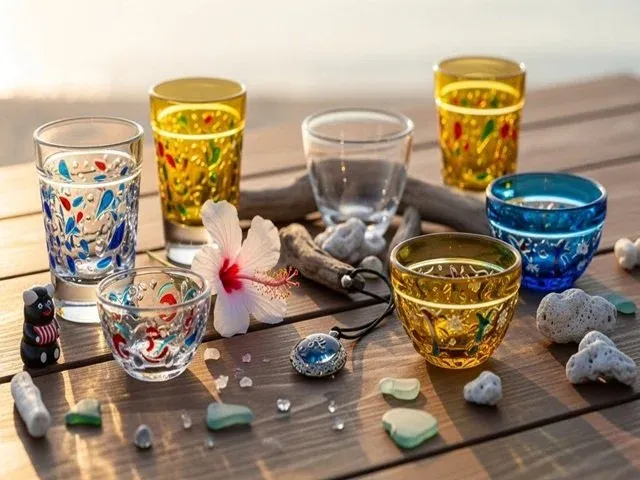
Okinawa's glass factories were destroyed in the 1945 Battle of Okinawa. With raw materials scarce and US service members placing orders for everyday tableware, surviving artisans did what they had to: they washed, crushed, and re-melted discarded American glass bottles. Beer bottles turned the glass brown. Coca-Cola bottles made it blue. Seven-Up bottles made it green. Whisky bottles created that soft, hazy turquoise you see on every souvenir shelf today.
The tiny air bubbles left behind by label residue and bottle caps were originally seen as defects. Artisans started treating them as features. That became the craft's signature, and what makes every piece genuinely one-of-a-kind.
Today, Ryukyu glass is recognized as an Official Traditional Craft of Okinawa Prefecture, and around 30 certified producers operate across the island. What sets it apart from mainland Japanese glassware is exactly this: intentional imperfection. Thick walls, visible bubbles, and swirled color gradients born from recycled glass and using age-old technique handed down through generations.
If two pieces look identical, they weren't made by hand.
What Happens in a Glass Blowing Workshop?
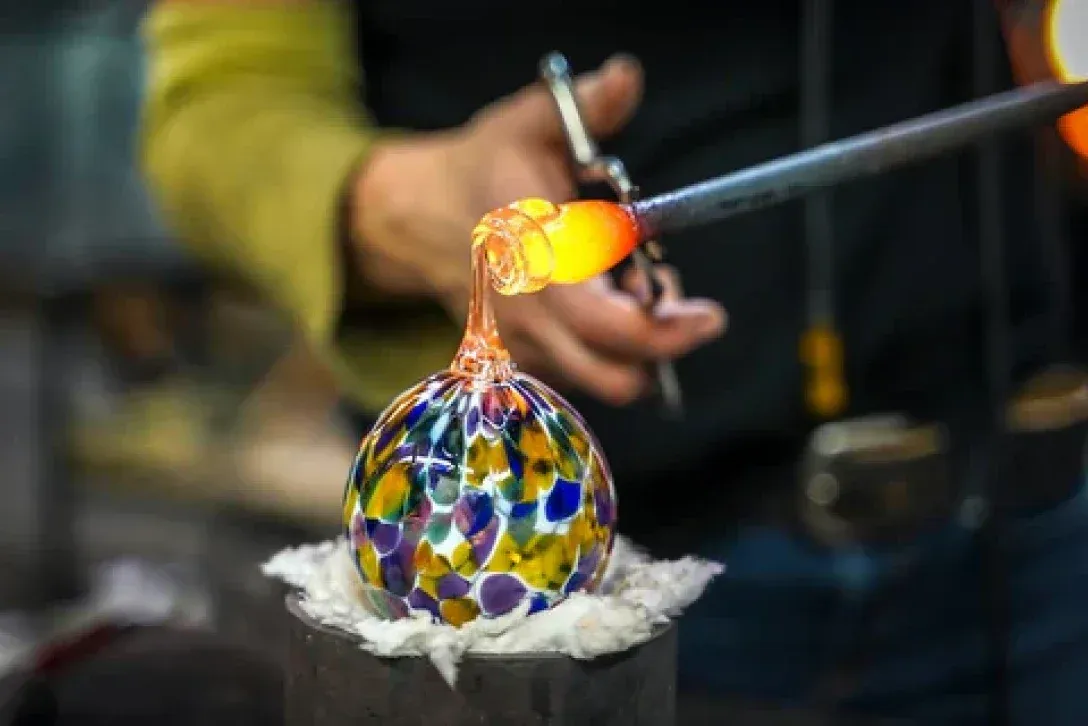
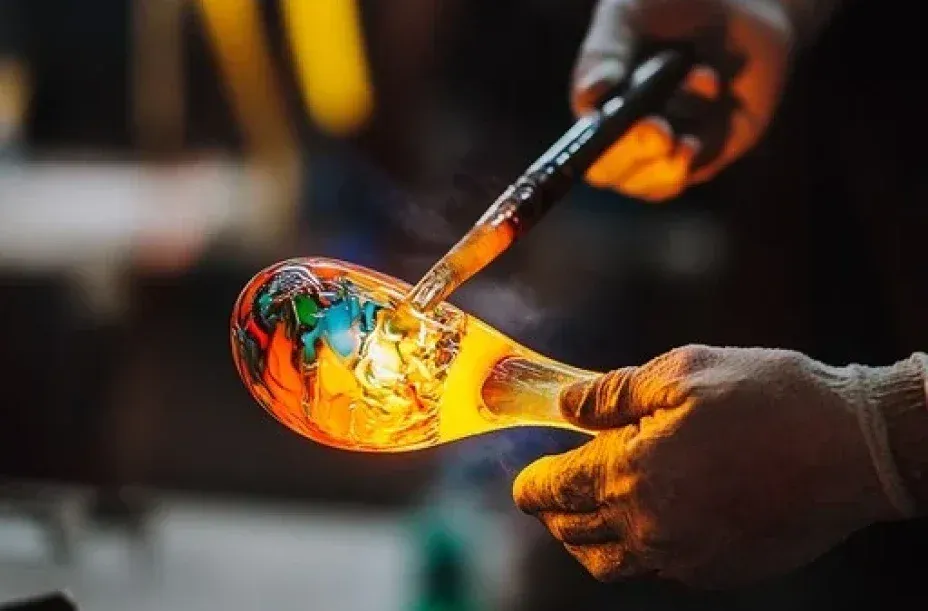
You arrive at the glass workshop, choose your shape from picture cards, a rocks glass, a tumbler, a small vase, a heart shape, and pick your color palette. Then you put on an apron and arm covers and step into a studio where the temperature regularly exceeds 40°C because the kilns run at 1,300–1,500°C.
Watch skilled artisans shape molten glass on a long metal blowpipe, then it gets handed to you. You blow, steadily, not forcefully, while turning the pipe slowly. The artisan uses tongs and shears to shape the piece around your blowing. Your glass slowly balloons and takes form. The artisan then opens the mouth of the glass and transfers it to the cooling oven.
The whole hands-on portion takes roughly 10-15 minutes. The studio experience including briefing and waiting is closer to 30 minutes total.
Your piece needs to cool slowly for 24–48 hours. You either return the next day to collect it, or pay extra to have it shipped home.
Who Is Ryukyu Glassblowing Best For?
Glassblowing is the most exciting of the three workshops. The heat, the glow, the 1,300°C kiln behind you, it's visceral in a way bingata and pottery aren't. Couples love it. Families with school-age kids love it. Even solo travelers who come in nervous usually leave grinning.
It's not the best choice if you have same-day luggage constraints and can't accept shipping, or if you're traveling with very small children (most studios recommend a minimum age of around 8 due to the heat).
It also suits people with zero artistic ability, the artisan literally does the hard work. You just blow and turn when told.
Best Ryukyu Glass Workshops to Book
Ryukyu Glass Village (Workshop Think Think) is the landmark option, located in Itoman, about 30 minutes south of Naha Airport by car. It's the largest handmade glass studio in Okinawa, founded in 1985 and home to several nationally recognized master artisans. Glassblowing sessions run at set times (10:00, 11:00, 13:00, 14:00, 15:20) and cost ¥4,400. Advance booking is strongly recommended in peak season. Some staff speak English and the website has a multilingual booking page.
One important note: the retail floor at Ryukyu Glass Village sells a mix of Okinawa-made and Vietnam-made glass. The sister factory in Hanoi produces glass under technical guidance from Okinawa, it's not fake, but it's not locally made. Look for the "Made in Okinawa" sticker or ask directly before buying.
Naha City Traditional Crafts Center (Tenbusu Naha) on Kokusai-dōri is the most convenient option if you don't have a car. It sits right on the main tourist street and runs glassblowing sessions (with a local kiln's artisan) for ¥1,500–¥3,500 depending on the piece. Walk-ins are sometimes accepted, but pre-booking is wiser. Closed Wednesdays. The center also showcases various items including Ryukyu lacquerware and tsuikin lacquer inlay work alongside the glass experience, making it a great introduction to Okinawa's wider craft culture, and if you're heading north toward Nago, studios in Onna Village are a good follow-up.
Onna Glass Studio and Teida Glass Studio, both in Onna Village in northern Okinawa, about an hour north of Naha, offer a slightly more boutique atmosphere. Prices run a bit higher, but the setting is quieter and coastal. These really require a rental car.
Practical tips:
- Wear closed-toe shoes and tie back long hair
- Avoid loose synthetic fabrics (they melt near heat)
- Arm covers are provided, but short sleeves underneath are more comfortable
- Budget ¥1,000–¥4,400 extra for domestic or international shipping
- Your finished glass is not tempered, no hot drinks, no dishwasher, no microwave
Bingata Dyeing : The Most Beginner-Friendly (and Most Royal) Bingata Experience
What Is Bingata and Where Does It Come From?
Of the three crafts, bingata has the most extraordinary origin story, and the most royal pedigree.
This traditional Okinawan dyeing art emerged in the 14th and 15th centuries during the Ryukyu Kingdom's golden age of maritime trade. Think of it as a collision of textile traditions from across Asia: Indian block-printing, Javanese batik, Chinese stencil dyeing with cinnabar pigments, and Japanese Kyō-Yūzen technique, fused into something entirely Okinawan. The vibrant colors and patterns that resulted were unlike anything produced elsewhere in Asia.
The result was fabric so vibrant that a Chinese envoy visiting in 1802 wrote in his records that the flowers on Ryukyu cloth were "so vivid they must have been produced using a secret unrevealed to others."
Under the Ryukyu Kingdom, bingata was strictly status-coded. Yellow-ground fabric was reserved exclusively for the royal family. Pale blue was for the aristocracy. Smaller patterns indicated the samurai class. Only three licensed families, the Shiroma, Chinen, and Shōma lineages, were permitted to produce bingata for the royal court.
The craft nearly died twice. First in 1879 when Japan abolished the kingdom and ended royal patronage. Again in 1945 when the battle destroyed most workshops, stencils, and tools. Postwar artisans improvised with whatever they could find: army maps became stencils, broken phonograph records became spatulas, even lipstick was used as pigment.
Today, bingata is a nationally designated traditional craft of Japan, the only one of the three crafts covered here to hold that status, and all three original royal lineages survive and continue working.
What Happens in a Bingata Workshop?
This is where bingata surprises most visitors: it's far more accessible than it looks.
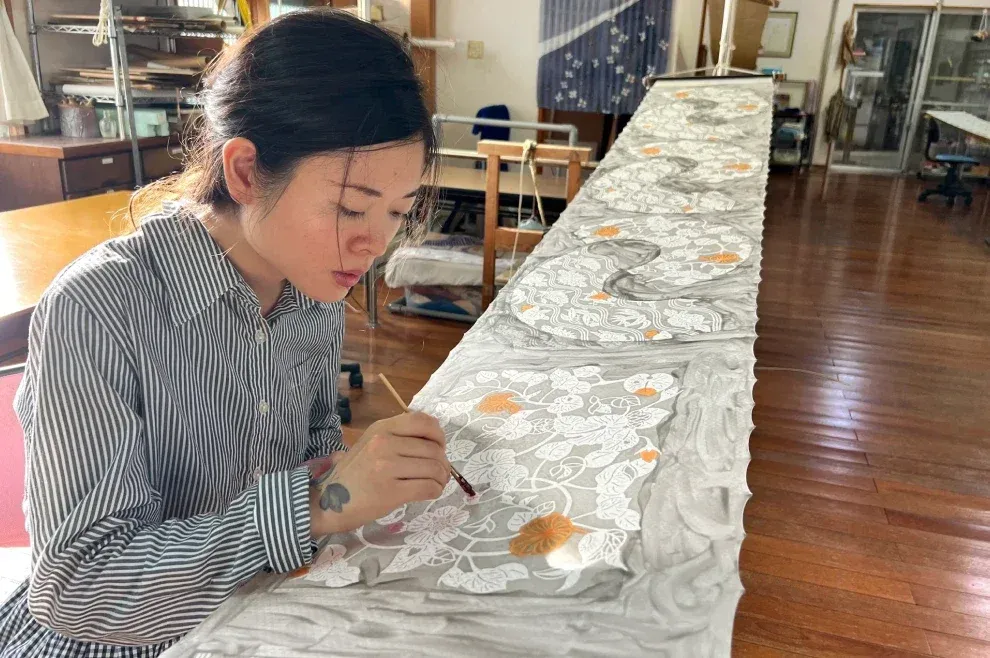
The standard tourist experience at Shuri Ryusen, the best-known bingata studio for English-speaking visitors, uses a technique called traditional Okinawan dyeing with coral fossils. You choose an item to work on (a t-shirt, tote bag, scarf, handkerchief, or furoshiki wrapping cloth), select your colors from natural plant-based pigments, and then place real fossilized coral pieces, mounted on blocks, under the fabric. You rub pigment over the cloth, and the coral's intricate texture transfers as a pattern. Layer a second or third color and the result is genuinely beautiful.
More experienced studios also offer stencil dyeing: applying resist paste through a perforated stencil, brushing on pigment in passes, shading with a smaller brush (the "kumadori" technique that gives bingata its distinctive three-dimensional look), steaming to set the color, and washing away the paste. Tourist sessions use a simplified version of this process, but the fabric you produce using these traditional techniques still looks like the real thing.
Sessions run 50–90 minutes. You sit down, get comfortable, and work at your own pace.
Who Is Bingata Best For?
Bingata is the most accessible of the three — no heat, no physical demand, no prior skill required. It works for virtually every traveler type.
Families with young children do brilliantly here, kids as young as preschool age can participate with adult help. Solo travelers who want time to be creative and thoughtful find it meditative. Couples on a short trip appreciate that they can walk out with a finished souvenir on the same day, making it the easiest take home option of the three crafts.
If you only have one or two nights in Naha, bingata is probably your smartest choice: the studio is close to Shuri Castle (you can combine both in a single morning), it doesn't require a rental car, and you leave with something you can actually wear or use.
The only thing bingata doesn't offer is adrenaline. It's calm and careful, not dramatic.
Best Bingata Workshops in Okinawa
Shuri Ryusen is the standout for tourists. Located just a 7-minute walk from Shuri Castle in the Shuri area, it was founded in 1973 by master dyer Kōtō Yamaoka and is the only place in Japan that offers coral fossil dyeing. Sessions cost ¥3,000 for adults and ¥2,500 for children (materials included: the item itself, all pigments, and instruction). Five session times daily: 9:30, 11:00, 12:30, 14:00, and 15:30. Booking is done through their website. The Yui Rail gets you to Shuri Station in about 15 minutes from central Naha, then it's a short walk.
Shuri Textile Museum "Suikara" is a newer facility built partly in response to the 2019 Shuri Castle fire, designed specifically to preserve bingata and shuri-ori weaving traditions. Visitors can observe shuri weaving demonstrations alongside the dyeing workshops. Tote-bag dyeing experiences run ¥3,520–¥4,950 depending on the piece size and number of colors. Sessions last 60–90 minutes. Also in the Shuri area.
Tenbusu Naha on Kokusai-dōri offers bingata among its five craft options, convenient if you're already on the main tourist street and want to try multiple crafts in one building.
Practical tips:
- Wear something you don't mind getting a small dye mark on (aprons are provided but accidents happen)
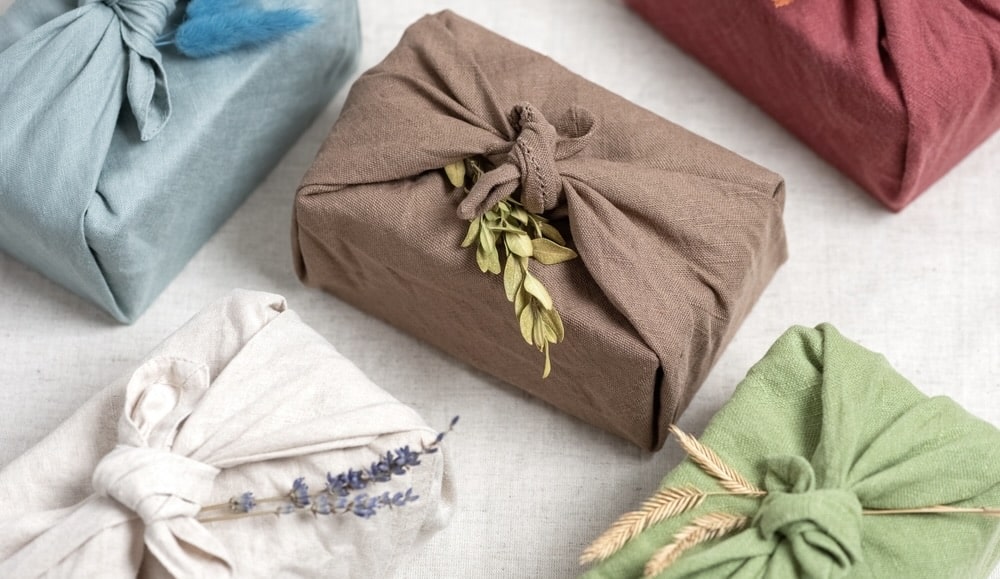
- Your finished piece goes home with you the same day, with a care manual
- Be wary of "bingata" items in souvenir shops: machine-printed fabric doesn't have the kumadori shading inside each motif or pigment penetration to the reverse side of the cloth, both signs of authentic hand-dyeing
Yachimun Pottery : The Most Meditative and Culturally Layered Workshop
What Is Yachimun and What Makes It Different?
"Yachimun" is simply the Okinawan word for pottery, but the craft behind it is anything but simple.
Local kilns date back to the Gusuku era of the 12th–14th centuries, but the tradition as it exists today was shaped by a remarkable collision of outside influences. In the early 17th century, the Ryukyu Kingdom invited Korean potters (via the Satsuma Domain) who brought wheel-throwing and high-fired glazing techniques. In 1682, King Shō Tei consolidated scattered kilns from three different Okinawan towns into the Tsuboya district of Naha, creating what we now know as Tsuboya pottery, protected by the state, sold across the Asia-Pacific trade network.
What makes yachimun unlike any other Japanese pottery is its DNA. The curved dachibin hip flask, Okinawa's most iconic ceramic form, was directly modeled on Thai Sawankhalok jars that arrived via maritime trade. Chinese celadon passing through Ryukyu ports influenced glaze chemistry. Korean potters laid the wheel-throwing foundation. The result is the most cosmopolitan traditional Ryukyu craft in Japan, a living artifact of the Ryukyu Kingdom era, shaped across centuries of trade, and the kind of Ryukyu Kingdom-era legacy you can hold in your hands.
Visually, yachimun is earthy and bold: thick walls, plump shapes, vibrant cobalt blues and iron reds, and motifs of fish, prawns, peonies, and arabesque scrolls. An interesting detail for collectors: authentic pieces fired in stacked kilns often show a white "halo" ring at the center of plates, where the foot of the plate above pressed against the glaze below during firing. That mark became a symbol of authenticity.
Today, yachimun carries the heaviest institutional recognition of the three crafts. The Tsuboya district is Okinawa's only nationally registered traditional pottery site. Individual potters have earned the title of Living National Treasure, most famously Kinjō Jirō, who became Okinawa's first in that category and whose refusal to abandon his wood-fired kiln when smoke regulations changed led directly to the founding of today's Yachimun no Sato in Yomitan.
What Happens in a Pottery Workshop?
Unlike glass (where the artisan does most of the physical work) or bingata (where you follow a structured stencil), pottery gives you real creative latitude, which means more variability in results.
The main workshop options are:
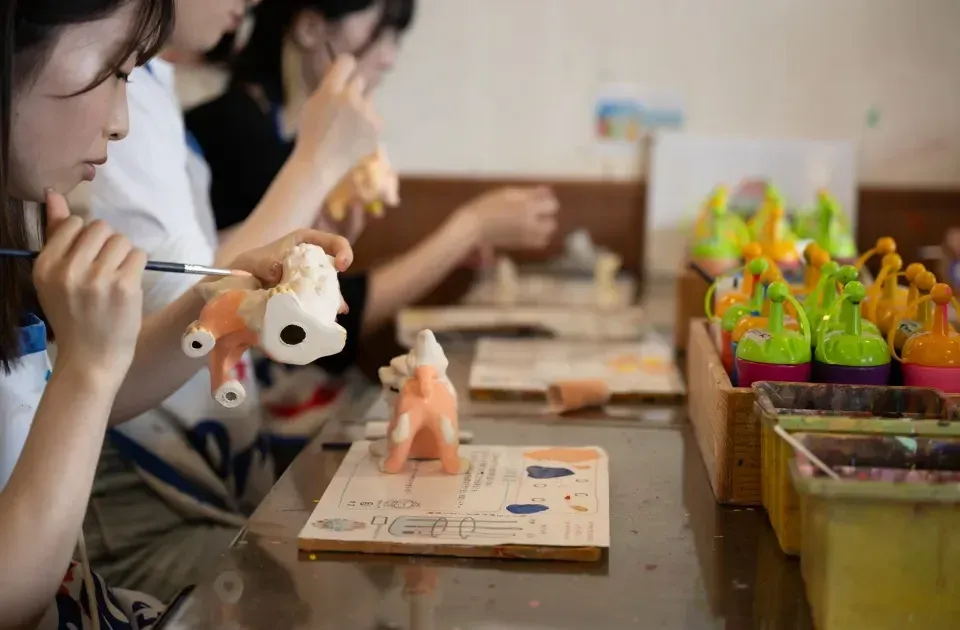
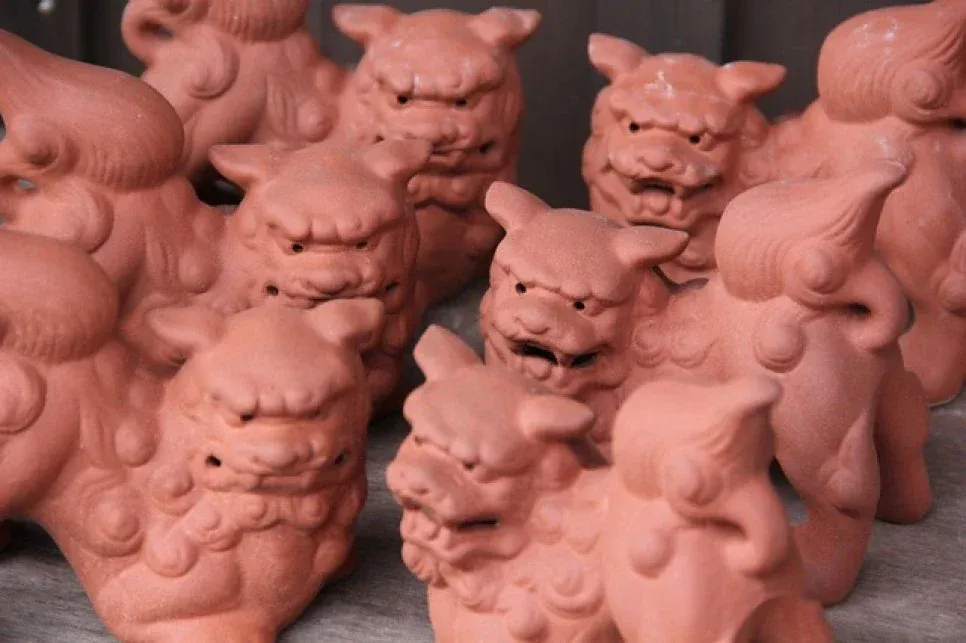
Shisa making: the most popular entry point for first-timers and families. You hand-build a ceramic shisa lion-dog, one of the iconic Okinawan guardian lion-dogs said to ward off evil spirits, from rolled clay, attaching legs, ears, fangs, and a curly tail, then add personality with a stylus. The wobbly, hand-made look is the point. This takes 60–90 minutes.
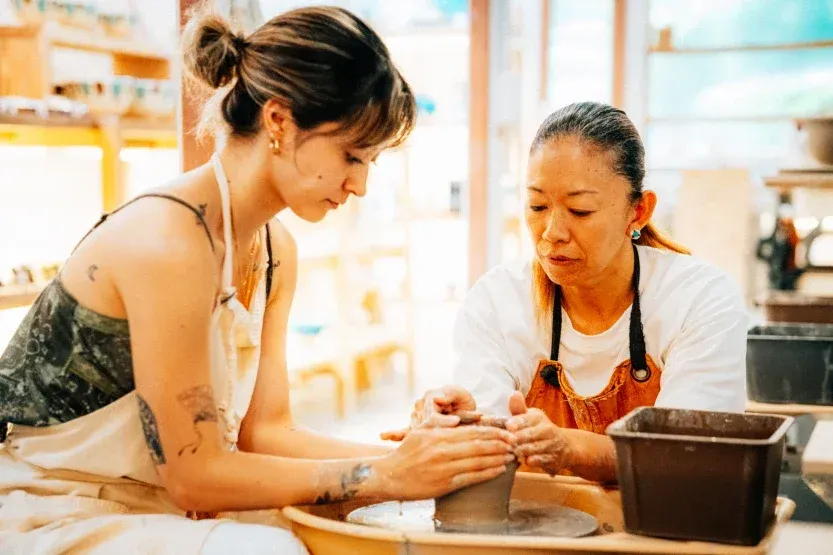
Wheel-throwing (rokuro): you sit at an electric wheel with an artisan guiding your hands, centering the clay and drawing up walls into a cup, bowl, or small plate. This is the hardest of the three options and results vary, beginners often produce something charmingly asymmetrical.
Hand-building (tebineri) : coil-and-pinch construction on a small turntable. More forgiving than the wheel and produces surprisingly good results.
Painting (etsuke) : applying traditional cobalt and iron glazes onto a pre-thrown unglazed bisque piece using brushes. This is the closest to an immediate-gratification experience within the pottery options, and sometimes processes faster for shipping.
The big trade-off with pottery is time. After your session, the piece needs to be dried, bisque-fired, glazed, and high-fired. That takes 1–2.5 months. Shipping is arranged by the studio and not included in the workshop price. International shipping for ceramics is expensive due to weight and fragility.
Who Is Yachimun Best For?
Pottery is the right choice if you're in Okinawa for five days or more and genuinely care about craft heritage, not just as a tourist activity, but as a reason to visit Tsuboya Yachimun Street or Yomitan Village, browse working studios, and understand what you're making before you sit down at the wheel. For deeper context before your session, the Okinawa Prefectural Museum in Naha has a permanent exhibition of artifacts from the Ryukyu Kingdom alongside displays on the island's unique craft traditions, it pairs well with a morning at Tsuboya. The broader Okinawa world cultural landscape, from historic castle sites to living craft studios, gives this pottery tradition its remarkable depth.
It's also perfect for anyone who collects Japanese ceramics or has always wanted to try your hand at wheel-throwing. The shisa-making option is great for families with kids from about age 5 up.
It's the wrong choice if you're on a short trip, hate waiting for shipping, or want something to carry home in your luggage. It's also not ideal for travelers who want a guaranteed beautiful result, yachimun pottery is the most skill-dependent of the three.
Best Pottery Workshops in Okinawa
Ikutōen Yachimun Dōjō is the most accessible option for first-timers without a car. Located on Tsuboya Yachimun Street in Tsuboya, a 10–15 minute walk from Kokusai-dōri, this workshop is run by the 6th-generation Takaesu family, with a kiln lineage of about 300 years. Wheel-forming starts at ¥4,950; hand-building at ¥3,850; shisa-making around ¥2,500–¥3,000. Reservations are required. Some staff speak basic English. Aprons are provided; remove rings and watches before the session.
Yachimun no Sato in Yomitan is where the serious pottery enthusiast should go. This village of 19+ independent workshops, built on former US military land in the 1970s, houses kilns of the highest artistic pedigree in Okinawa, including Living National Treasure lineages. Walking through the forest paths between stone-walled workshops, past 13-chamber climbing kilns that fire only twice a year, is a genuinely moving experience. The cooperative shops are excellent for purchasing. Hands-on tourist sessions are available but must be booked in advance; it's about 45–50 minutes by car from Naha (or an hour-plus by bus).
Tenbusu Naha on Kokusai-dōri also offers Tsuboya pottery sessions among its five crafts, handy if you want a quick intro without committing to a full workshop visit.
Practical tips:
- Remove rings and watches before the session, clay gets everywhere
- Wear clothes you don't mind getting dirty; aprons are provided but clay splashes
- Budget for shipping separately: postage for a single piece within Japan runs a few thousand yen; international shipping significantly more
- Ask your studio for tracking and estimated delivery dates when you book, some studios communicate more proactively than others
- Authentic yachimun feels heavy for its size, shows slight thickness variation inside, has a rough foot ring, and bears the potter's mark on the base
How to Choose: A Simple Decision Framework
Still unsure? Use this:
Go with glassblowing if you want the most dramatic, memorable experience, something you'll still be talking about at dinner. It's brief, visually stunning, and beginner-proof. Just make sure your schedule allows for shipping or a return pickup.
Go with bingata if you want the easiest, most flexible option, something beautiful that you can take home the same day, works for all ages, and connects you to the deepest royal history of the three crafts. It's also the best rainy-day plan.
Go with yachimun if you're a craft lover, a ceramics enthusiast, or a traveler who appreciates meaning over convenience. The wait is long, but the result is something genuinely made from the oldest pottery tradition in Okinawa.
If you can only do one and you're a first-time visitor to Okinawa with a standard 4–5 day trip: choose bingata at Shuri Ryusen. You can combine it with Shuri Castle, you don't need a car, you take something beautiful home the same day, and you leave with a tangible connection to the most royal craft tradition the island has.
Best combinations if you have more time:
- Glassblowing in Itoman (morning) + Peace Memorial Park (afternoon), great day trip heading south
- Bingata at Shuri Ryusen (morning) + Shuri Castle (after), perfect half-day in the Shuri area
- Yachimun pottery in Tsuboya (morning) + walking Kokusai-dōri (afternoon), both are within easy walking distance
- For the craft obsessive: Tsuboya pottery + Yomitan Yachimun no Sato as a full-day pottery pilgrimage (requires a car)
Practical Tips for Booking Craft Workshops in Okinawa
Book early.
During Golden Week (late April–early May), summer school holidays (mid-July through August), and the Tsuboya and Yomitan pottery festivals in November–December, popular sessions sell out days in advance. Bingata at Shuri Ryusen in particular fills up fast, book at least 3–5 days ahead during peak season.
Confirm English availability.
Shuri Ryusen, Ryukyu Glass Village, Teida Glass, and Ikutōen all have some English-speaking staff or English materials. Smaller artisan studios may require a translation app. Don't assume, email or check the studio's website before booking.
Check cancellation policies.
Most studios require at least 24-hour notice. Same-day cancellations are generally charged in full.
Do you need a car?
For Tsuboya pottery and Shuri Ryusen bingata, no, both are reachable by monorail and walking. For Ryukyu Glass Village in Itoman and Yomitan Yachimun no Sato, a rental car makes life much easier. Buses exist for both, but schedules are limited.
Don't shop for "Okinawa crafts" at the airport before visiting a workshop.
Most airport and Kokusai-dōri souvenir items labeled "Ryukyu glass," "bingata," or "Okinawa pottery" are mass-produced versions. These cultural experiences are worth seeking out in their authentic form, after doing a workshop, you'll instantly spot the difference, and you'll want the real thing.
FAQ
Which Okinawa craft workshop is best for beginners?
Bingata dyeing is the most beginner-friendly of the three. There's no heat, no physical strength required, no wheel to wrestle with, and even kids as young as preschool age can participate with adult help. The stencils and coral fossils used in most tourist sessions mean your finished piece looks far more polished than you'd expect for your first try.
Can I take my creation home the same day?
It depends on the craft. Bingata pieces are yours the same day, that's one of its biggest advantages. Some glass studios have quick-cool pieces available within hours, but most require 24-48 hours. Pottery takes 1-2.5 months to fire and ship; there's no way around this.
How much do craft workshops cost in Okinawa?
Most fall in the ¥3,000–¥5,000 range (roughly $20–$35 USD), with materials and instruction included. Pottery sessions can run slightly higher for wheel-throwing. Shipping costs are extra for glass and pottery.
Do I need to book craft workshops in advance in Okinawa?
Yes, especially for popular options like Ryukyu Glass Village and Shuri Ryusen. During peak season, the best time slots fill days in advance. Walk-ins are sometimes possible at quieter studios and at Tenbusu Naha, but it's always safer to reserve ahead.
Are Okinawa craft workshops suitable for children?
Bingata and shisa pottery-making are excellent for kids from about age 5. Wheel-throwing pottery works well for children from about age 8. Glassblowing involves exposure to a kiln exceeding 1,300°C, most studios recommend a minimum age of around 8, and children must be old enough to stand steadily and follow instructions carefully.
Where are the best craft workshops in Okinawa?
For glassblowing: Ryukyu Glass Village in Itoman (the main destination) or Tenbusu Naha for convenience. For bingata: Shuri Ryusen near Shuri Castle is the top choice for English-speaking visitors. For pottery: Ikutōen Yachimun Dōjō in Tsuboya (central Naha, no car needed) or Yachimun no Sato in Yomitan (car recommended, deeper experience).
Can I do a craft workshop without speaking Japanese?
Yes, at the major tourist-facing studios. Shuri Ryusen, Ryukyu Glass Village, Teida Glass, and Ikutōen all have English staff or English-language materials. For smaller independent studios, a translation app on your phone goes a long way. Always confirm before booking.
How do I know if Ryukyu glass is actually made in Okinawa?
Look for a "Made in Okinawa" label, or buy directly from a certified workshop floor. Authentic handmade Ryukyu glass has visible air bubbles, slight asymmetry, and no two pieces look identical. Mass-produced or overseas-made pieces tend to be perfectly uniform, thinner, and significantly cheaper. At Ryukyu Glass Village specifically, the workshop-floor pieces and the Contemporary Master Craftsmen gallery items are made on-site; many retail-floor items are produced at the sister factory in Vietnam.
Prices, session times, and availability were current at time of research but can change, always confirm directly with the studio before your visit.
Evertrail Tours · May 9, 2026